Our AI product development method. From constraint to production.

Our AI product development method connects business judgment, product design, data, and engineering from the first decision through handoff. Each stage produces a useful decision or a working part of the system.

Delivery sequence

From constraint to an ownable production system.

The depth changes by engagement; the order of the questions does not.
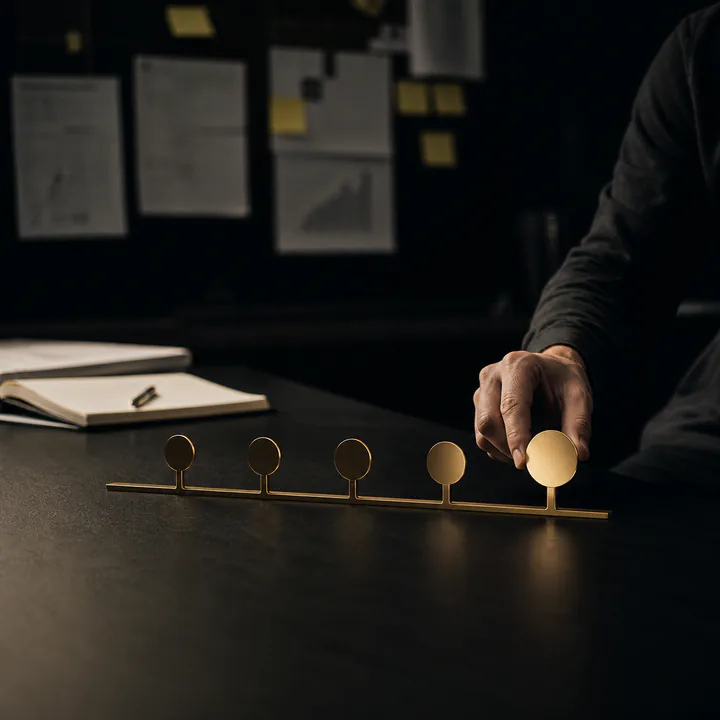
Project lead moving the fifth milestone into a measured delivery sequence
01Frame

Define the decision

Name the user, workflow, outcome, constraint, and evidence that would justify the work.

02Inspect

Understand the current system

Review the product, data, architecture, operating context, and dependencies already in place.

03Prove

Test the riskiest assumption

Use a focused prototype or technical spike to find out what the larger plan depends on.

04Deliver

Build the production path

Design, engineer, integrate, validate, and release the smallest complete version that can create value.

05Transfer

Make ownership explicit

Document the system, decisions, controls, and next priorities for the team operating it.

Engagement shapes

The same method at three levels of ownership.

AuditA decision-ready direction

Frame, inspect, and prove enough to choose the right investment and delivery sequence.

Ends with explicit findings, tradeoffs, and an ordered plan.

DeliveryA working production release

Carry the agreed direction through design, engineering, integration, validation, and handoff.

Ends with an operational system and documented ownership.

PartnerA continuing product rhythm

Stay connected to the roadmap, operating signals, and changing business context after launch.

Ends only when continuing ownership no longer creates useful leverage.

Review gates

Three questions control the next investment.

Is the problem worth solving?

The result matters to a customer, operator, or business decision.

Can the system support it?

The necessary data, access, integration, review, and operating conditions can be made reliable.

Is the next step proportionate?

The proposed scope tests or delivers something valuable without hiding the important risk.

Evidence at every stage

Each stage changes what the team knows and what it is ready to own.

Our AI product development process is a delivery framework, not a fixed calendar. Product engineering, data, cloud, and AI implementation move through the same decisions at different depth depending on the constraint and the evidence already available.

A shared problem frame

The team agrees the user, workflow, business outcome, system boundary, dependencies, and constraints. Open assumptions are recorded so later design and engineering work can test them directly.

A current-state view

Existing product behavior, architecture, data flows, tools, access, people, and operating conditions are reviewed in proportion to the decision. Useful investments are preserved instead of being replaced by default.

A risk-focused proof

A prototype, technical spike, data sample, or workflow simulation tests the uncertainty most likely to change the plan. The proof has an explicit question and acceptance condition rather than serving as a polished demo.

A complete release boundary

The first production scope includes the interfaces, integrations, data, controls, tests, documentation, and ownership needed for useful operation. Features outside that boundary remain visible without weakening the first release.

A reviewable launch

Release plans identify the initial users, instrumentation, support, escalation, and decision points. Product use, system behavior, and operational feedback determine whether the next investment should expand, correct, or stop the work.

An ownable handoff

Source code, system decisions, runbooks, controls, known limits, and next priorities transfer with the working system. The internal team can explain how it operates and where a future change should be reviewed.

Start with the constraint

Tell us what must change and what cannot break.

We will help you define the first decision, the right engagement shape, and the smallest useful scope.

FAQ

Questions buyers ask before they start

Do all engagements follow every stage?

They follow the same logic, but not the same duration or depth. A focused audit may stop after proving the main assumption; a delivery continues through production and handoff.

Can our team own part of the delivery?

Yes. Ownership can be divided by workstream as long as the interfaces, decisions, review points, and acceptance conditions remain explicit.

What happens if the first audit changes the project?

That is useful. The purpose of the early stage is to change or stop a weak plan before the expensive part of delivery begins.